
Special formats · Transparent
Transparent LED wall rental for your trade fair stand
A transparent LED wall shows video while letting people see what is behind it. At a trade fair it is the answer when you don't want to block a shop window, a display case or a glass front. We rent it for stands with transport, installation, a technician on site for the whole fair and dismantling, and before we propose it we tell you frankly whether it is the right option for you.
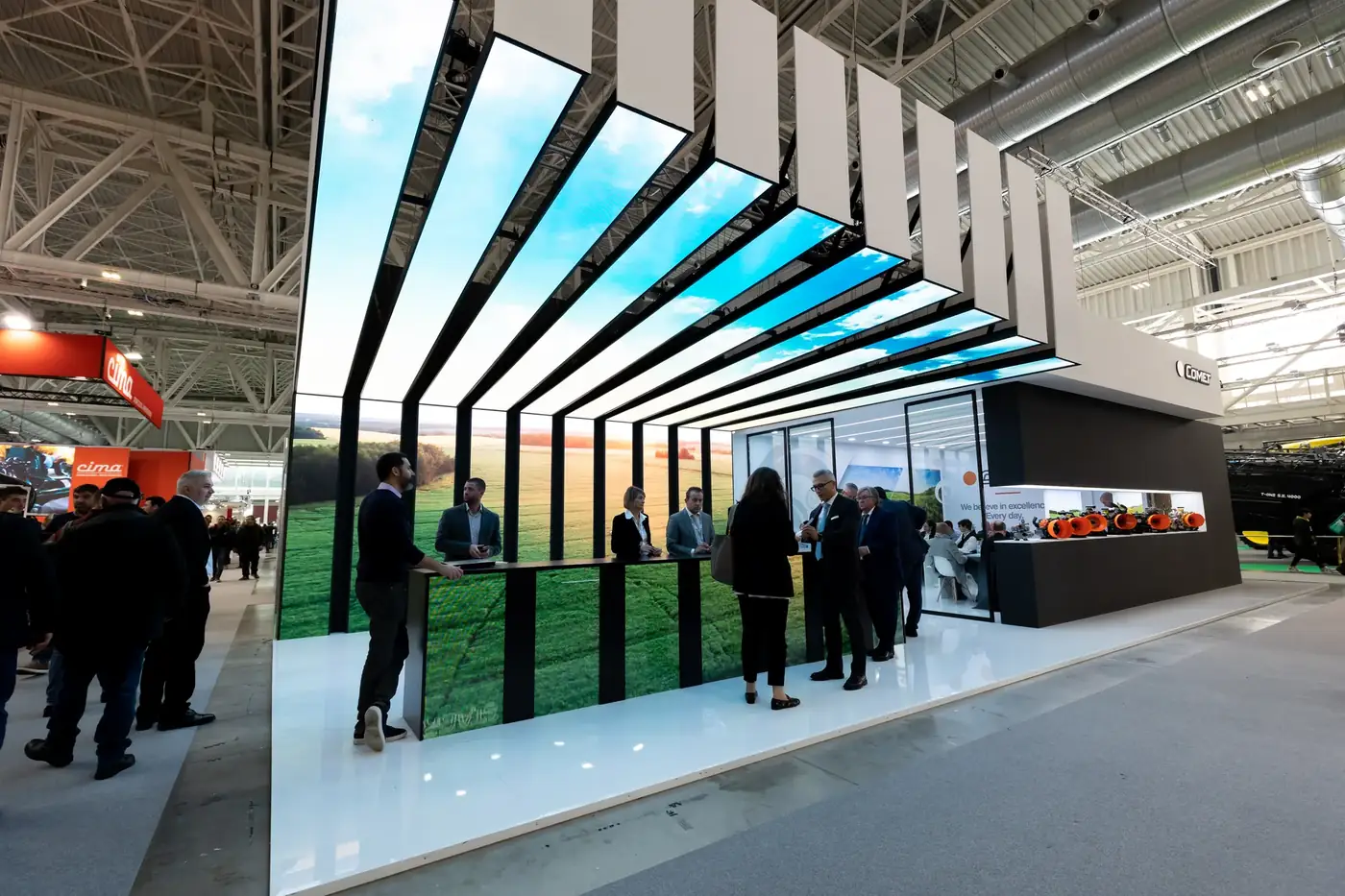
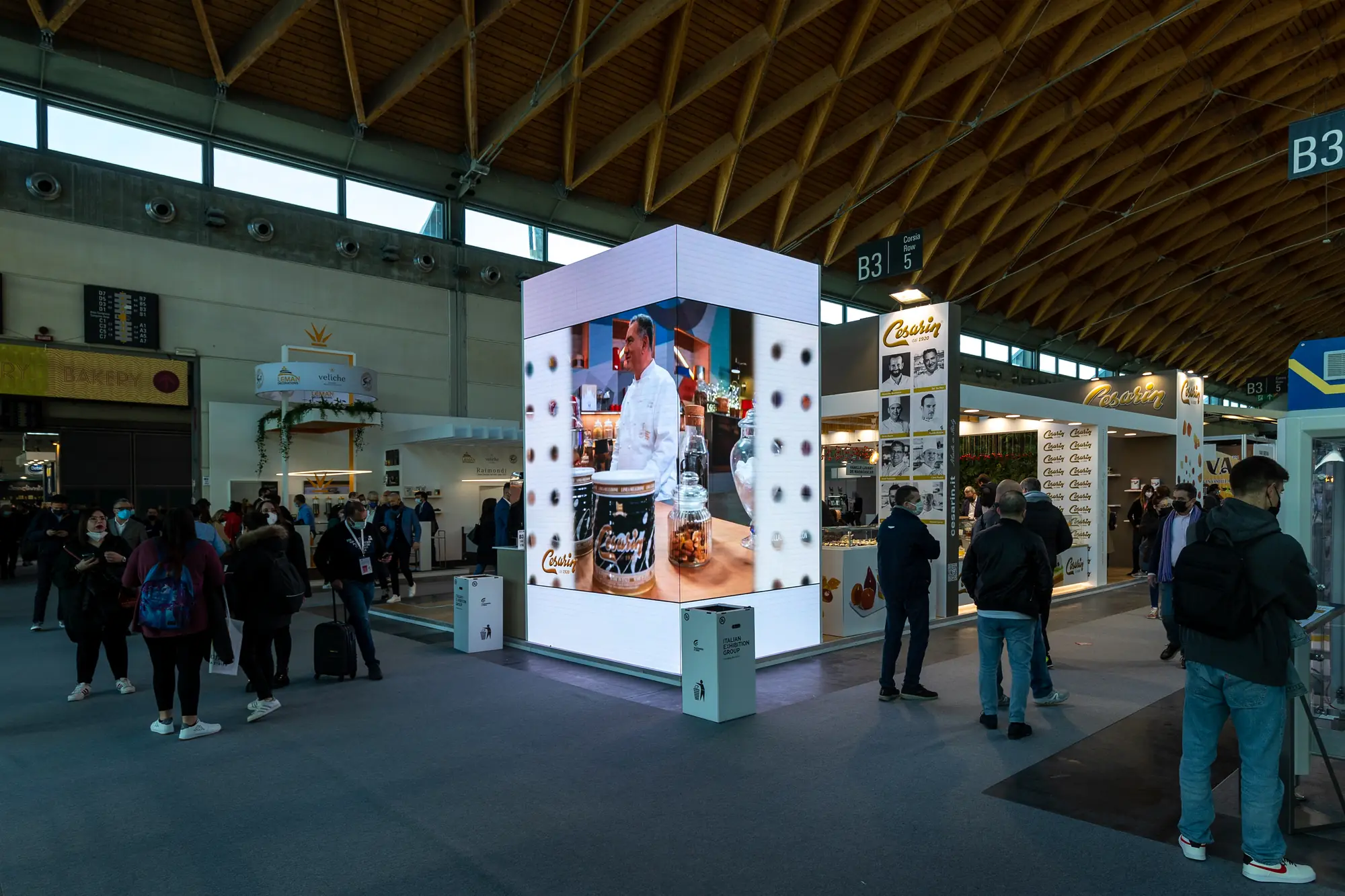
Euroledwall installations at European trade fairs
The images show other Euroledwall installations at trade fairs.
What it is and the role it plays on a stand
A transparent screen is made of LED strips mounted on a frame, with gaps between them that let light and sight pass through. From the front you see the video; behind it, whatever is there stays visible: the product, the meeting room, the people working on the stand. It lets you layer images over a space without hiding it completely.
At a trade fair it makes sense wherever the stand is about light and openness: a shop window facing the aisle with the real collection behind it, a product display case that needs a message without losing visibility, a partition between the exhibition area and the private zone that you don't want to turn into a blank wall. For design, fashion, jewellery and retail brands, which care a great deal about how open their space feels, it is a very expressive tool.
When we recommend it and when we don't
Transparency can reduce image contrast. On this type of screen black isn't displayed, it becomes see-through, and under the strong lighting of an exhibition hall the video has less contrast than on a standard LED wall. If your goal is a brand video that reads from the far end of the aisle, a conventional screen of the same size usually has more impact.
The transparent wall wins when what you see behind it is part of the message. A perfume on a plinth with particles of light floating in front of it, a motorbike in the window with its specifications overlaid, a jewellery case that comes to life without ceasing to be a display case: these are cases where transparency can genuinely add something to the stand. That is why, before confirming anything, we go through the stand design and what you want to communicate with you, and if we think a standard screen will work better for you, we say so.
Content designed for a screen you can see through
Video for a transparent screen is prepared differently. Black areas emit no light and let the viewer see more of what is behind the screen. Floating luminous elements, short bold text, logos and animations that move in and out without filling the whole frame all work well. A corporate video made for television, with full-screen light backgrounds, covers exactly what you wanted to show.
Send us the content as MP4 a few days before installation and we test it at the screen's actual resolution. If something won't read under the hall lighting, we tell you in time to fix it.
When the stand has more than one screen, the transparent one usually carries the simpler content and the conventional screen the longer video. That way each does what it does best: the first hints at the story and lets the product show through, the second tells the full story to visitors who come closer.
Structure and installation within the stand
A transparent screen can stand on a floor-level frame or be suspended from the stand structure, depending on the design. Either way, the stand builder needs to plan for it from the start: we send the data sheet with dimensions, weight and power consumption so they can prepare the fixings and the power supply. Whether it can be hung depends on what the fair organiser allows and on the stand structure, and we confirm this before committing.
On installation day we arrive once the structure is ready, install the screen and leave it tested with your video before the fair opens. Throughout the fair one of our technicians is on site for any adjustment, and when the fair closes we dismantle it and take it away.
For design studios and stand builders
The idea of a transparent screen often comes from the studio designing the stand. If that's you, we work as your technical supplier: we study the render with you, suggest where to place the screen so the effect is visible from the aisle, and deliver it integrated into your structure. The relationship with the exhibitor stays yours. To talk it through: +39 049 838 0040 or info@euroledwall.eu.
01 · At the fair
Ideas for your stand
How it could work at some European trade fairs
Maison&Objet Paris
Paris
A glass shop window facing the aisle, with the real collection behind it and the image floating in front.
Trade fairs in Paris →Vicenzaoro September
Vicenza
A screen in front of the display case with black backgrounds, adding movement without hiding the jewellery.
Trade fairs in Vicenza →Cosmoprof Worldwide Bologna
Bologna
Above the product shelf, bringing the packaging to life without stealing its spotlight.
Trade fairs in Bologna →Salone del Mobile.Milano
Milan
A partition between the exhibition area and the meeting room, without closing the stand off with a wall.
Trade fairs in Milan →EuroShop
Düsseldorf
A digital shop window for retail brands, at the fair where the stand itself is judged like a shop.
Trade fairs in Düsseldorf →02 · FAQ
Frequently asked questions
03 · Quote
Shall we look at it on your floor plan?
Tell us which fair you are exhibiting at and where you want the screen: we tell you whether it fits and prepare the quote.
Prefer to call? The office in your language
- Italian office+39 049 838 0040
- German office+49 30 2178 4011
- French office+33 1 87 65 17 15
- Spanish office+34 911 239 796