
Special formats · Curved
Curved LED wall rental for trade fair stands
A curved LED wall follows the architecture of the stand instead of interrupting it. It can be concave, to wrap around whoever is in front of it, or convex, to be seen from several angles at once. We rent it with structural planning, transport, installation, a technician for the whole fair and dismantling.
Euroledwall installation at a trade fair
Euroledwall installation at a trade fair
Concave or convex: two different effects
A concave curve opens towards the visitor, like a small cinema. It's the one used to create an immersive space: a presentation area with seating, a demo corner, the backdrop to a stage on the stand. Depending on the arc and where the visitor stands, the image can feel enveloping.
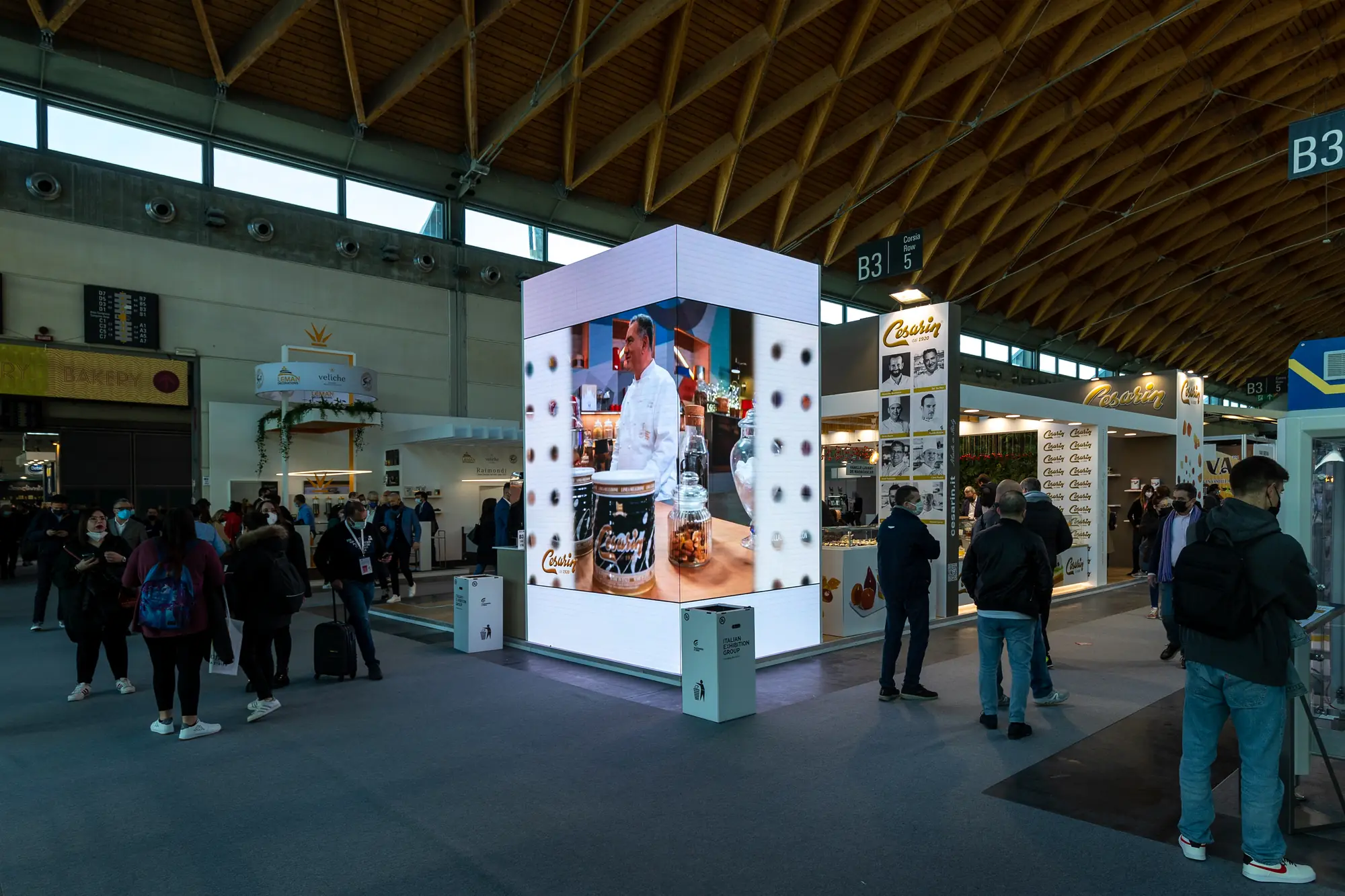
A convex curve does the opposite: it opens outwards and can be read from several points along the aisle. It works on columns, rounded corners and island stands, where people arrive from different directions. It's an elegant way to have one screen work for two or three sides.
To choose between them, the question is where the people are. If the audience sits or stops in front of it, go concave. If they walk around it, go convex. And if the stand has a curved wall by design, we need to check whether the screen can follow that curve so it looks built into the stand rather than added afterwards.
Sizes and installation of a curved LED wall
Our reference drawings use curvatures of 2.5° and 5°, both concave and convex: the first gives a gentle curve that follows a wall, the second a more pronounced arc. The technical data sheets cover concave sizes such as 3 × 2 m, 4 × 2.5 m, 4.5 × 2.5 m, 5 × 4 m and 8 × 3.5 m, and convex sizes such as 3 × 1.5 m, 3 × 2.5 m and 3.5 × 3.5 m.
With 50 × 50 cm modules we can look at other combinations of width, height and curvature. We work it out on the stand render to check how the screen fits into the structure.
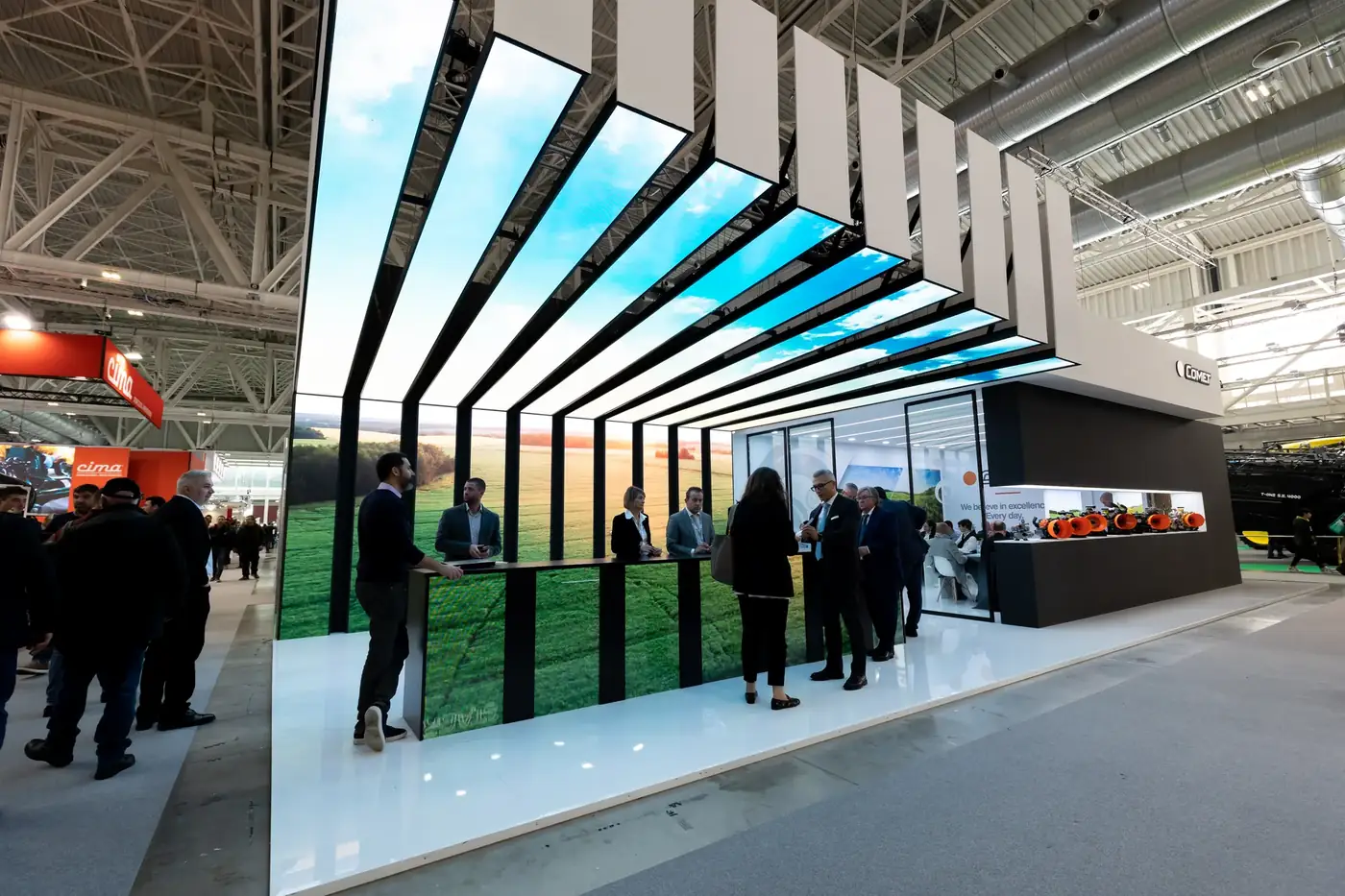
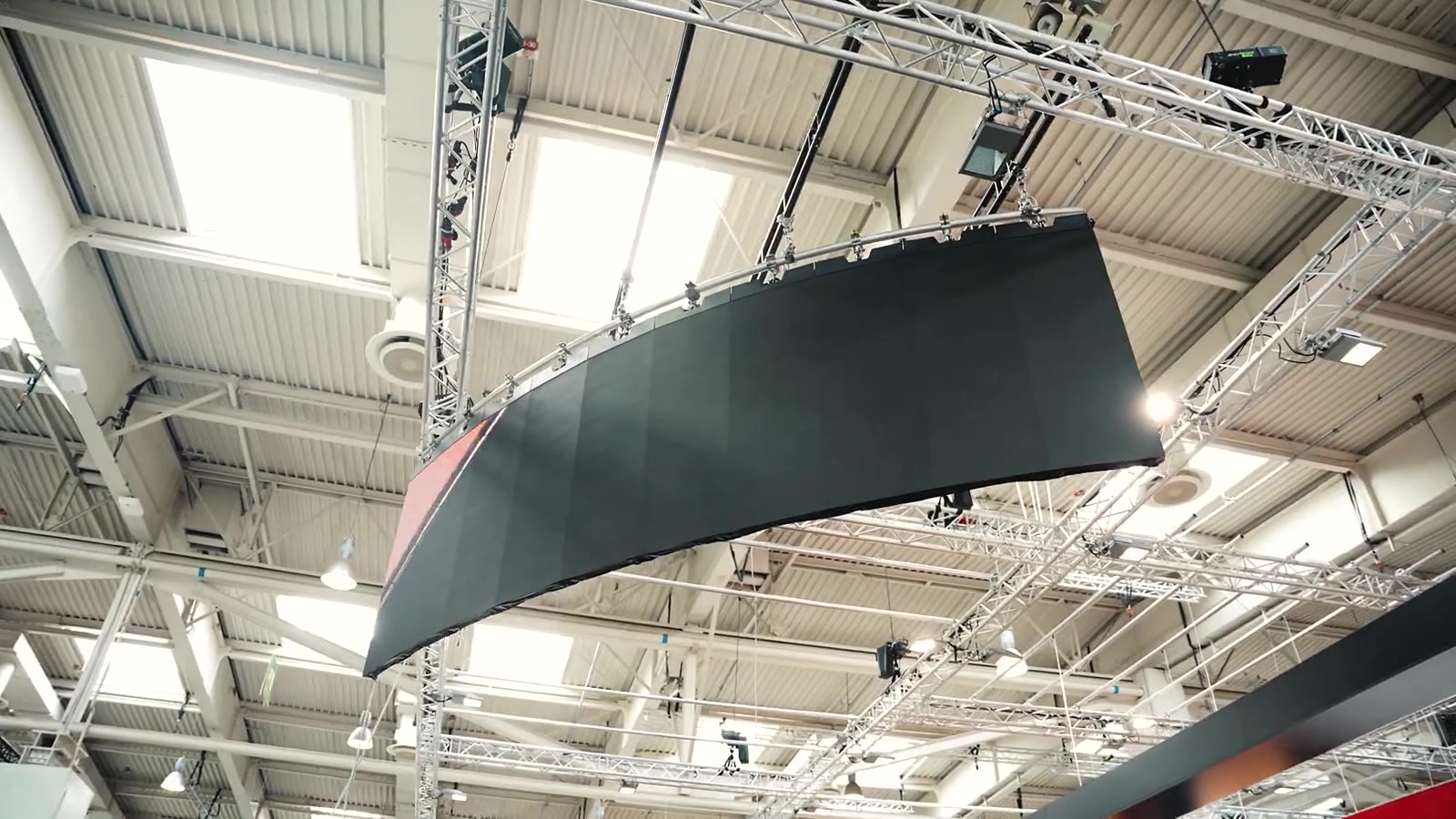
A curved screen can also be hung or integrated into ceiling elements of the stand, such as slats or suspended bands, when the design and the fair organiser allow it. These solutions are assessed case by case with the stand builder, from the first render.
The structure a curve requires
A curved screen needs the stand builder to prepare its opening with the same curvature: a support base able to carry 35 kg per square metre of screen and anchoring structures on each side. For a 5 × 4 m concave screen, for example, the base must carry about 700 kg. Wherever possible we also ask for access behind the screen and for the power outlets to be at the back.
Maximum consumption is 800 W/m², so that same 5 × 4 m screen reaches 16 kW, and we recommend a dedicated distribution board. If the curve is hung from the stand ceiling, as in some installations over bar or presentation areas, it depends on what the fair organiser authorises, and we confirm this before proposing it.
Content for a curved surface
A curved screen is usually wide, and content has to be designed for that proportion. We give you the exact resolution in pixels and suggest making the most of the width: landscapes, camera moves, a product entering on one side and leaving on the other. Text goes in the central area, the part seen head-on, and stays away from the ends, where the curve visually distorts it.
We test the video on the installed screen before the fair opens, and during the fair the technician can switch content if you have a presentation at a set time.
On a concave screen designed for a seated audience, it also pays to keep anything important out of the lower corners, which the front row's heads will block. We check this against the seating plan if you have one.
Fairs where a curve makes the difference
A curve makes sense at fairs where the stand is judged as architecture: furniture, lighting, design, automotive, audiovisual. At an industrial products fair it also works as the backdrop to a presentation area or a small auditorium within the stand.
With architecture studios and stand builders we act as technical supplier from the render stage: we propose curvature and size, send the dimensions of the opening and deliver the screen installed within its structure. The studio or stand builder remains the exhibitor's point of contact. To discuss a project: +39 049 838 0040 or info@euroledwall.eu.
01 · Technical data
From our technical data sheets
- Types
- Concave and convex
- Curvatures in the reference drawings
- 2.5° and 5°
- Concave sizes with technical data sheet
- 3 × 2 m · 4 × 2.5 m · 4.5 × 2.5 m · 5 × 4 m · 8 × 3.5 m
- Convex sizes with technical data sheet
- 3 × 1.5 m · 3 × 2.5 m · 3.5 × 3.5 m
- Maximum power consumption
- 800 W/m² (16 kW for a 5 × 4 m concave screen)
- Support base load
- 35 kg per m² (700 kg for a 5 × 4 m concave screen)
- Electrical installation
- Industrial 16 A single-phase (220 V) or 32 A three-phase (380 V) sockets; a dedicated distribution board is recommended
Values from Euroledwall’s technical data sheets. The exact figures depend on the format and model we install at your fair; we send them with the quote.
02 · At the fair
Ideas for your stand
How it could work at some European trade fairs
Salone del Mobile.Milano
Milan
A concave curve following the stand wall and wrapping around the area where the collection is presented.
Trade fairs in Milan →IAA MOBILITY
Munich
A convex screen behind the vehicle, readable from several points in the hall.
Trade fairs in Munich →ISE · Integrated Systems Europe
Barcelona
A concave screen for immersive demos to small groups.
Trade fairs in Barcelona →Light + Building
Frankfurt
A curve suspended above the luminaires, with brightness adjusted so it doesn't compete with them.
Trade fairs in Frankfurt →Cersaie
Bologna
A convex screen on a stand column, showing the tiles laid in real projects.
Trade fairs in Bologna →03 · FAQ
Frequently asked questions
04 · Quote
Shall we look at it on your floor plan?
Tell us which fair you are exhibiting at and where you want the screen: we tell you whether it fits and prepare the quote.
Prefer to call? The office in your language
- Italian office+39 049 838 0040
- German office+49 30 2178 4011
- French office+33 1 87 65 17 15
- Spanish office+34 911 239 796